Knee replacement differs from a repair in which the closure can rest after surgery. In total knee arthroplasty (TKA), the patient is frequently encouraged to get out of bed on the first postoperative day, with flexion targets commonly moving from about 90 degrees in the first week toward 120 degrees within the first month. The capsular closure is therefore loaded in repeated, cyclic tension from the moment it is sutured, rather than after a period of quiet healing. In that sense the knee offers one of the most demanding environments a surgical suture can encounter.
As the knee flexes, the patella shifts laterally and pressure inside the joint cavity rises sharply. Repeated over hundreds of cycles, this movement subjects every part of the closure to changing strain. A suture line that appears secure at rest can behave differently once the joint begins to move. The practical consequence is not only mechanical; it is biological. Joint fluid may track outward along an imperfectly sealed line, and organisms from the superficial tissues can find a route inward toward the implant.
The concern is not academic. A dominant failure mode after total knee arthroplasty is periprosthetic joint infection (PJI), a complication whose clinical weight is considerable. Published series describe high revision rates and substantial five-year mortality associated with PJI, in some analyses exceeding figures reported for a number of malignancies. The capsular closure is widely regarded as the final physical barrier between the external environment and the prosthetic joint space. How reliably that barrier is sealed is therefore a question of implant survival rather than merely of wound appearance.
(1) Dynamic Tension Resistance: As the knee flexes, intra-articular pressure rises and tension across the joint capsule surges. Traditional knotted sutures concentrate stress at isolated knot points, increasing the risk of tissue cut-through or knot failure.
(2) Watertight Joint Capsule Seal: The joint capsule acts as the primary physical barrier separating the prosthetic implant from superficial cutaneous bacteria. Any micro-gaps in the closure allow synovial fluid leakage outward and bacterial tracking inward.
(3) Prevention of Periprosthetic Joint Infection (PJI): PJI is a catastrophic complication in joint replacement, carrying a 5-year mortality rate higher than many common cancers. Securing an airtight, watertight barrier is paramount to preventing bacterial seeding.
(4) Reduction of Operative Time: Extended OR closure time directly correlates with higher Surgical Site Infection (SSI) rates. Every 15-minute increase in surgical duration exponentially raises infection risks.
To address the challenges mentioned above, the 2024 International Delphi Study on Wound Closure and Dressing Management in Joint Arthroplasty (published in the Journal of Arthroplasty) established a clear consensus: continuous barbed closure is strongly recommended for capsular and deep fascial layers in TKA and THA.
Key clinical advantages documented in Meta-Analyses and Randomized Controlled Trials (RCTs) include:
(1) Average 7-Minute Time Savings: Eliminating knot tying significantly reduces total OR closure time.
(2) Uniform Tension Distribution: A knotless suture features hundreds of micro-barbs acting as distributed anchors, reducing peak wound edge stress by 40–60% compared to metal staples or traditional knotted sutures.
(3) 40% Reduction in Suture Material Usage: Efficient continuous runs minimize total foreign body mass left inside the joint space.
While barbed sutures represent a major advancement, structural configuration determines performance in high-tension fascial closure.
[A] Helical / Spiral Barbed Suture — Barbs cut along a single spiral. Engages tissue on ONE side per cross-section.
[B] Symmetric Fishbone Barbed Suture — Opposing dual-sided barbs + central anchor zone. Engages tissue on BOTH sides simultaneously.
· Spiral Designs: Barbs wrap in a helix, leaving roughly two-thirds of the strand cross-section smooth at any single point. Under intense knee flexion, single-sided engagement can slip or rotate within tough fascial tissue.
· Symmetric Fishbone Designs: Opposing dual-sided barbs engage tissue on both sides simultaneously across the entire cross-section. This provides maximum pullout force and complete circumferential grip, ensuring the capsular seal remains watertight during rapid flexion recovery.
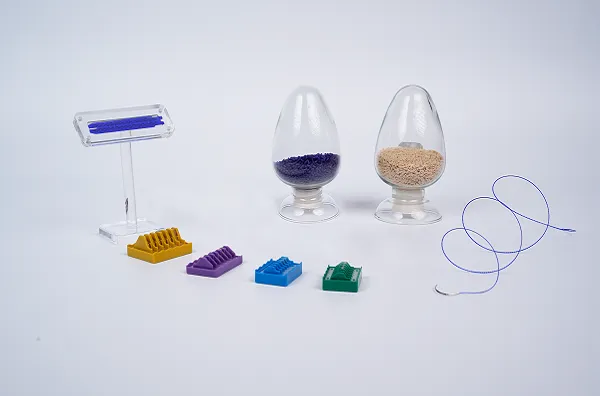
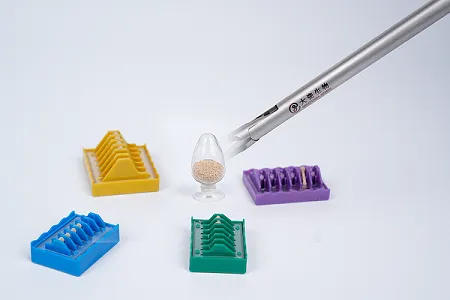
Established in 2022 in Jiangsu, China, Greatchina Biomed (www.gcbiomed.com) is an agile, technology-driven manufacturer specializing in absorbable biomaterials and minimally invasive surgical devices.
We are committed to full technical transparency. Rather than over-promising unverified claims, we provide international distributors with complete material traceability, rigorous in-vitro pullout test data, and full support for regional tender submissions.
Partnering Benefits with Greatchina Biomed:
· OEM / ODM & Private Label Capabilities: Tailored needle-suture combinations for regional surgical market demands.
· Competitive Margin Structure: Empowering regional distributors to challenge entrenched market monopolies with premium-quality PPDO technology.
· End-to-End Compliance Support: Direct access to technical documentation (TCF), EO validation reports, and stability data.
At Greatchina Biomed (www.gcbiomed.com), we engineer next-generation bioabsorbable surgical devices designed to give orthopedic and general surgeons complete confidence in high-tension closures.
By combining advanced PPDO monofilament chemistry with precision symmetric fishbone barb manufacturing, our goal is to deliver uncompromised joint closure security, reduced OR times, and superior patient rehabilitation.
Are you ready to offer your market a high-performance alternative in absorbable wound closure?
Request a Distributor Information Kit & Sample Portfolio or contact our International Affair Director at info@gcbiomed.com.
Contact Our Materials Science Division
We welcome you to reach out to us about our products, questions you may have or even suggestions on how we can improve.
Bldg 13, No.3 Hanshan Road, Xuejia Town, Xinbei District, Changzhou, Jiangsu 213125, China
 Call us on:
  Email Us:
  Bldg 13, No.3 Hanshan Road, Xuejia Town, Xinbei District, Changzhou, Jiangsu 213125, China