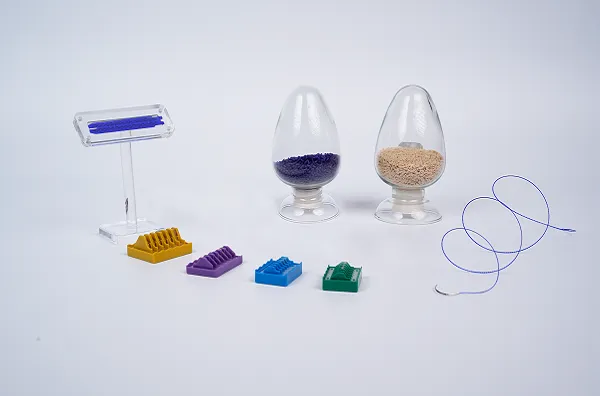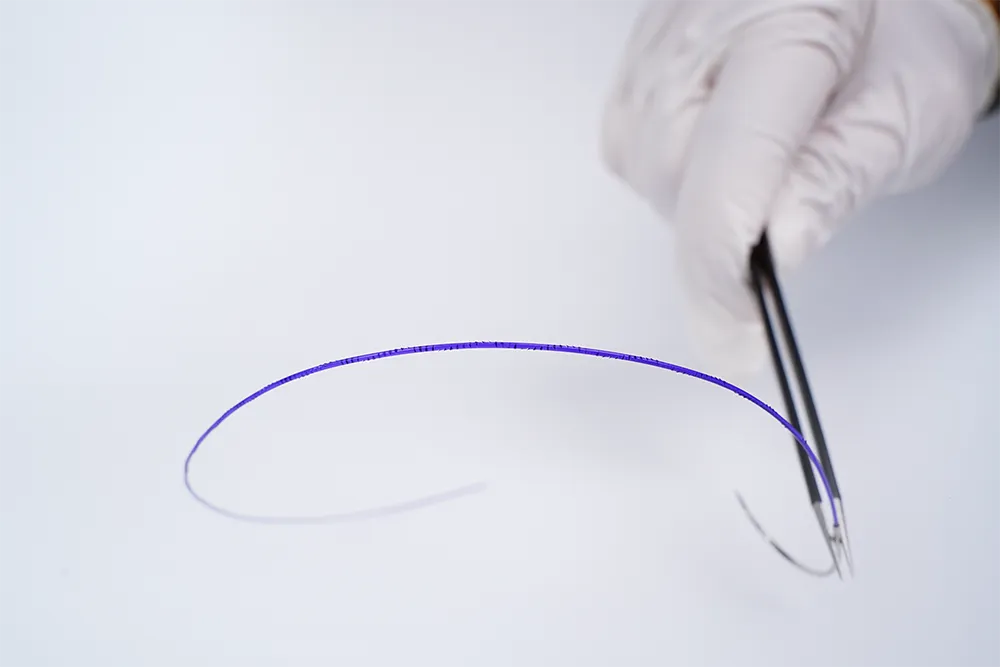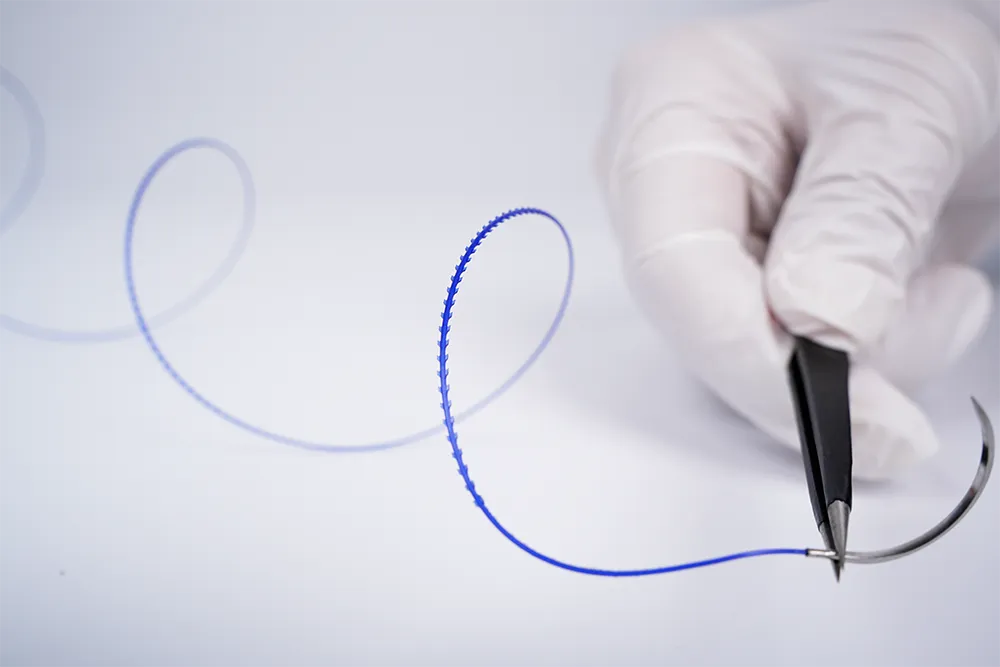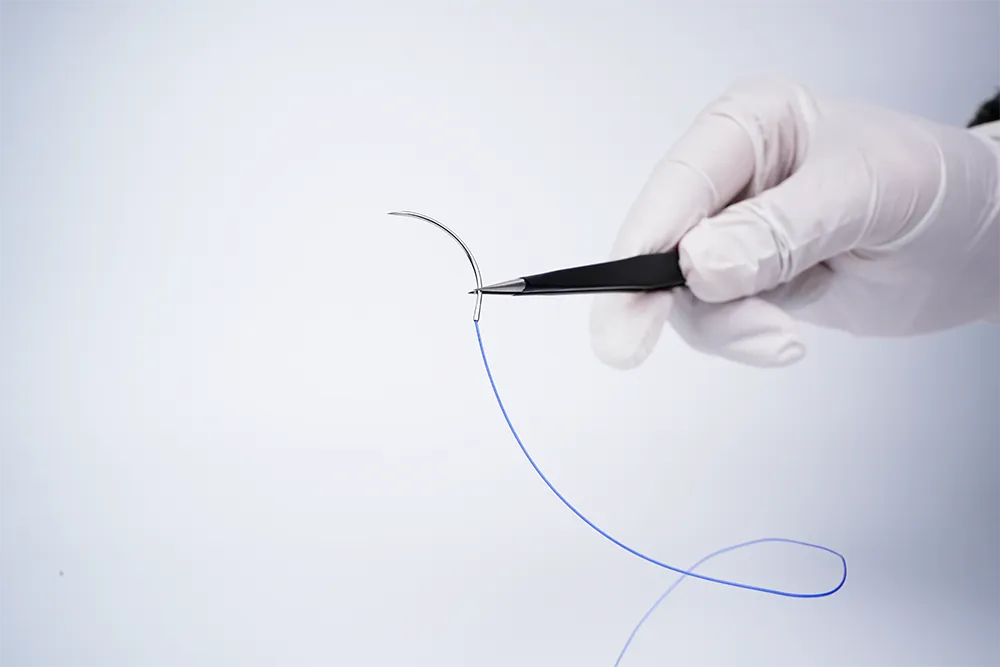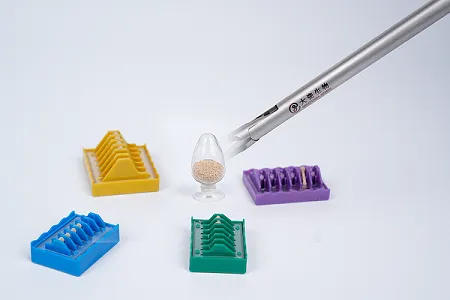

Born from incubated research by the Chinese Academy of Sciences (CAS), our PPDO (Polydioxanone) sutures represent a new echelon in absorbable technology. They are meticulously engineered to provide the surgeon with an optimal balance of robust tensile strength for secure closure and exceptional flexibility for superior handling. With a highly predictable absorption profile, our sutures ensure reliable tissue support during the critical healing period. Available in advanced barbed (fishbone) and traditional monofilament variants, Greatchina Biomed PPDO line offers versatile and trusted solutions for a breadth of surgical applications.
Controlled Absorption: Gradual breakdown to minimize inflammation
Excellent Tensile Strength: Supports wound healing without premature degradation
Sterile & Latex-Free: Reduces risk of allergic reactions
Sterile & Latex-Free: Reduces risk of allergic reactions
Monofilament, Fishbone, Barbed.
FISHBONE: 3-0, 2-0, 0, 1
BARBED: 4-0, 3-0, 2-0, 0, 1, 2
MONOFILAMENT: 7-0, 6-0, 5-0, 4-0, 3-0, 2-0, 0, 1, 2
Skin: Cutting or reverse cutting needle
Soft Tissue (bowel, vessels): Taper point
Laparoscopic: 1/2-circle needle
Total absorption time tells you when most of the material is expected to be eliminated, but the wound depends on the period during which the suture still provides meaningful mechanical support. Those are not the same timeline. A suture can lose much of its tensile strength well before complete absorption. That is why selection should focus first on the tissue's healing needs and the manufacturer's strength-retention data at relevant time points. Absorption behavior still matters for tissue response and long-term material burden, but it should not be used as a substitute for understanding functional support during the critical healing phase.
The choice starts with how long the tissue needs support. Rapidly healing tissue may be appropriate for a shorter-lasting absorbable suture, while fascia or other slower-healing structures may require extended support. Non-absorbable sutures can be useful where permanent tensile strength is needed. Other factors include contamination risk, tissue reactivity, knot security, handling, suture structure, patient factors, and whether later removal is practical. No single material is best for every layer of a wound. A sound approach is to match the suture's strength-retention and absorption profile to the expected healing curve, then consider handling and infection-related factors within the institution's approved protocols.
Needle choice influences penetration, tissue trauma, control, and the amount of force required. Cutting and reverse-cutting needles are commonly associated with tougher tissues such as skin, while taper-point needles are intended to separate rather than cut softer tissue. Curvature also matters: it determines the arc of travel and how easily the needle can be manipulated in open or restricted spaces. The needle should be matched to tissue density, access, bite depth, and the surgeon's technique. Suture material can perform well yet still feel unsuitable if the needle geometry is poorly matched to the procedure.
A distributor should ask for more than a catalog and price list. Important topics include the polymer source, manufacturing controls, size and needle range, sterilization method, shelf life, packaging integrity, batch traceability, complaint process, quality-system documentation, and registration status for the target country. Samples should be evaluated for needle attachment, strand consistency, memory, passage through tissue models, and knot handling. Disclosure: I work in international sales at a medical device company, so I see this from the supplier side. The strongest distributor relationships begin with a clear technical and regulatory checklist rather than a rush to sign an exclusivity agreement.
Suture size does not fully describe handling. Knot security can be influenced by polymer stiffness, surface characteristics, monofilament or barbed/fishbone structure, strand uniformity, coating, memory, and the knot configuration used. Technique also matters: the number and direction of throws, tension applied, wet handling, and whether the knot is properly seated can change performance. For that reason, a fair comparison should use the same knot method and test conditions. Surgeons should follow the product instructions and local practice standards rather than transferring assumptions from one material to another solely because the labeled size is the same.
Contact Our Materials Science Division
We welcome you to reach out to us about our products, questions you may have or even suggestions on how we can improve.
Bldg 13, No.3 Hanshan Road, Xuejia Town, Xinbei District, Changzhou, Jiangsu 213125, China
 Call us on:
  Email Us:
  Bldg 13, No.3 Hanshan Road, Xuejia Town, Xinbei District, Changzhou, Jiangsu 213125, China