
Specification of Knotless Absorbable Surgical Suture (Fishbone)
| OF Series: Only Single-Arm | |||||||||
| Suture Code | Size | Needle Type | shape | Needle Circle | Suture | Needle Length mm | |||
| I | 3-0 | 010, 015, 020, 025, 030, 035, 040, 045, 050, 055, 060, 065, 070, 075 | T | Taper point(flat) | E | 3/8 circle | I | 3-0 | 10-40 |
| J | 2-0 | 010, 015, 020, 025, 030, 035, 040, 045, 050, 055, 060, 065, 070, 075 | Y | Taper Cutting | K | 1/4 circle | J | 2-0 | 16-60 |
| K | 0 | 010, 015, 020, 025, 030, 035, 040, 045, 050, 055, 060, 065, 070, 075 | X | Dia Spatula | H | 1/2 circle | K | 0 | 25-75 |
| L | 1 | 010, 015, 020, 025, 030, 035, 040, 045, 050, 055, 060, 065, 070, 075 | Z | Trape Spatula | S | Straight | L | 1 | 25-80 |
| R | Reverse Cutting | F | 5/8 circle | ||||||
| D | Diamond Cutting | L | 1/2 curve | ||||||
| B | Blunt Point | B | Bi-Curve | ||||||
Fishbone vs Barbed: The Advanced Architectural Differences
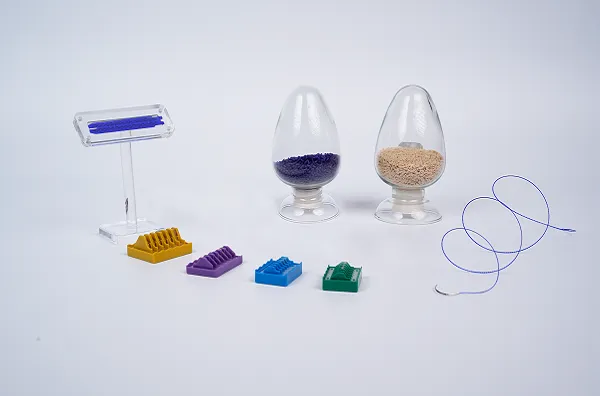
While both options facilitate knot-free surgery, Greatchina Biomed’s PPDO Fishbone (Knotless) Suture utilizes a highly specialized manufacturing architecture that distinguishes it from traditional cut-barbed designs. Engineered alongside the scientific excellence of the Chinese Academy of Sciences (CAS), our fishbone line delivers unmatched structural security through proprietary molding and geometric enhancements:
Bi-directional Symmetrical Anchoring:
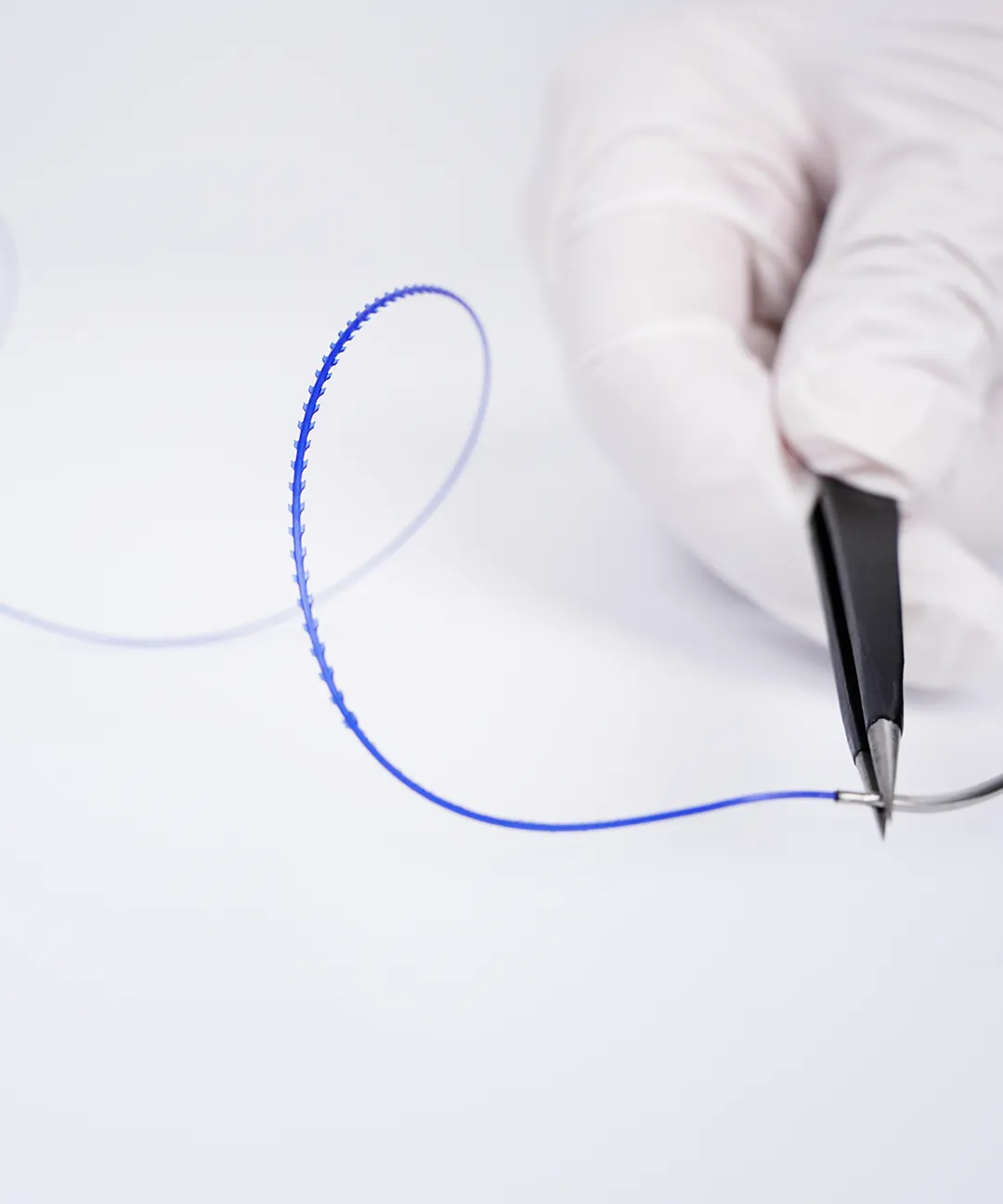
Unlike progressive linear barbs, the fishbone pattern features perfectly symmetrical, bi-directional anchoring structures. This dual-directional geometry allows the suture to initiate tension fixation right from the center of the incision, effectively balancing lateral physical forces and providing supreme gap prevention without shifting.
Preserved Core Tensile Integrity:
Traditional barbed cutting techniques can deep-slice into the suture's core, slightly reducing its overall tensile strength. Greatchina Biomed’s advanced fishbone technology molds or precision-shapes the geometric anchors without compromising the central core diameter. This ensures a significantly higher initial tensile strength and a more reliable, prolonged bio-absorption timeline.
Ultra-Smooth Material Profile with Lower Micro-Trauma:
The molded fishbone anchors deploy dynamically once embedded in host tissue but remain perfectly flush against the strand core during tissue passage. This unique mechanism dramatically reduces tissue friction and drag compared to standard cut barbs, effectively lowering the risk of biological chronic inflammation (BCI) and delivering superior cosmetic healing.
FAQ
What is a fishbone-style knotless tissue control device and how does it function?
A: A fishbone-style knotless tissue control device is an absorbable closure technology with wing-like projections on a central backbone that creates a ratcheting mechanism. It allows one-way advancement and cinching without knots. Made from absorbable polymers like polydioxanone, it offers positive tactile feedback during deployment. These knotless suture devices are commonly used in orthopedic and general surgery for tension-bearing closures.
What distinguishes fishbone knotless suture designs from traditional barbed sutures?
A: Fishbone knotless devices differ from traditional barbed sutures in several aspects: structural design (three-dimensional backbone with fins vs small barbs on a strand), locking mechanism (discrete ratcheting with audible feedback vs cumulative barb engagement), flexibility (stiffer requiring specialized instruments), tensile strength (higher), and tissue interaction (broader fixation area). Fishbone devices suit high-tension applications like bone approximation.
In which surgical applications are fishbone knotless devices most frequently indicated?
A: Fishbone knotless devices are most frequently indicated in orthopedic surgery for patellar, quadriceps, and Achilles tendon repair; cardiothoracic surgery for sternal closure after median sternotomy; general surgery for high-risk abdominal wall closure preventing incisional hernia; gynecologic surgery for pelvic reconstruction; and trauma surgery for fracture fixation constructs. Their ratcheting mechanism provides consistent tension under significant load.
What are the tensile strength and absorption profile considerations for fishbone knotless suture devices?
A: Fishbone knotless suture devices offer high tensile strength determined by material and backbone geometry, with ratcheting locks that withstand cyclic loading. Their absorption profile depends on polymer choice: polydioxanone provides extended retention over six months, while glycolide copolymers absorb faster. Complete absorption ranges from months to over a year. Selection should match strength retention to tissue healing requirements.
How should surgical teams be trained to handle fishbone knotless suture devices?
A: Training for fishbone knotless devices should include thorough study of manufacturer instructions, hands-on workshops with practice models for deployment technique, proctored clinical cases with real-time feedback, and team training for scrub and circulating nurses. Common pitfalls include over-advancement before cinching and excessive force during cinching. Ongoing education and outcome documentation ensure safe and effective use.
 Call us on:
  Email Us:
  Bldg 13, No.3 Hanshan Road, Xuejia Town, Xinbei District, Changzhou, Jiangsu 213125, China