
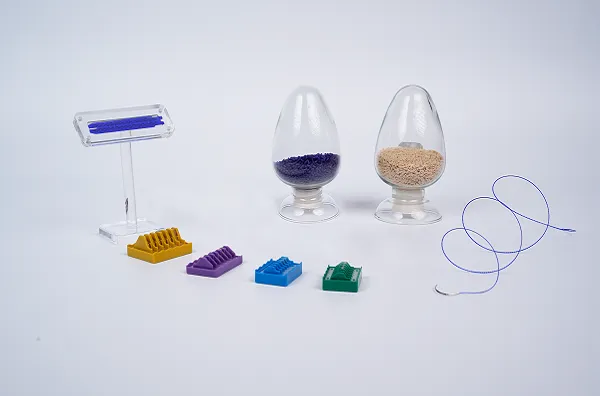
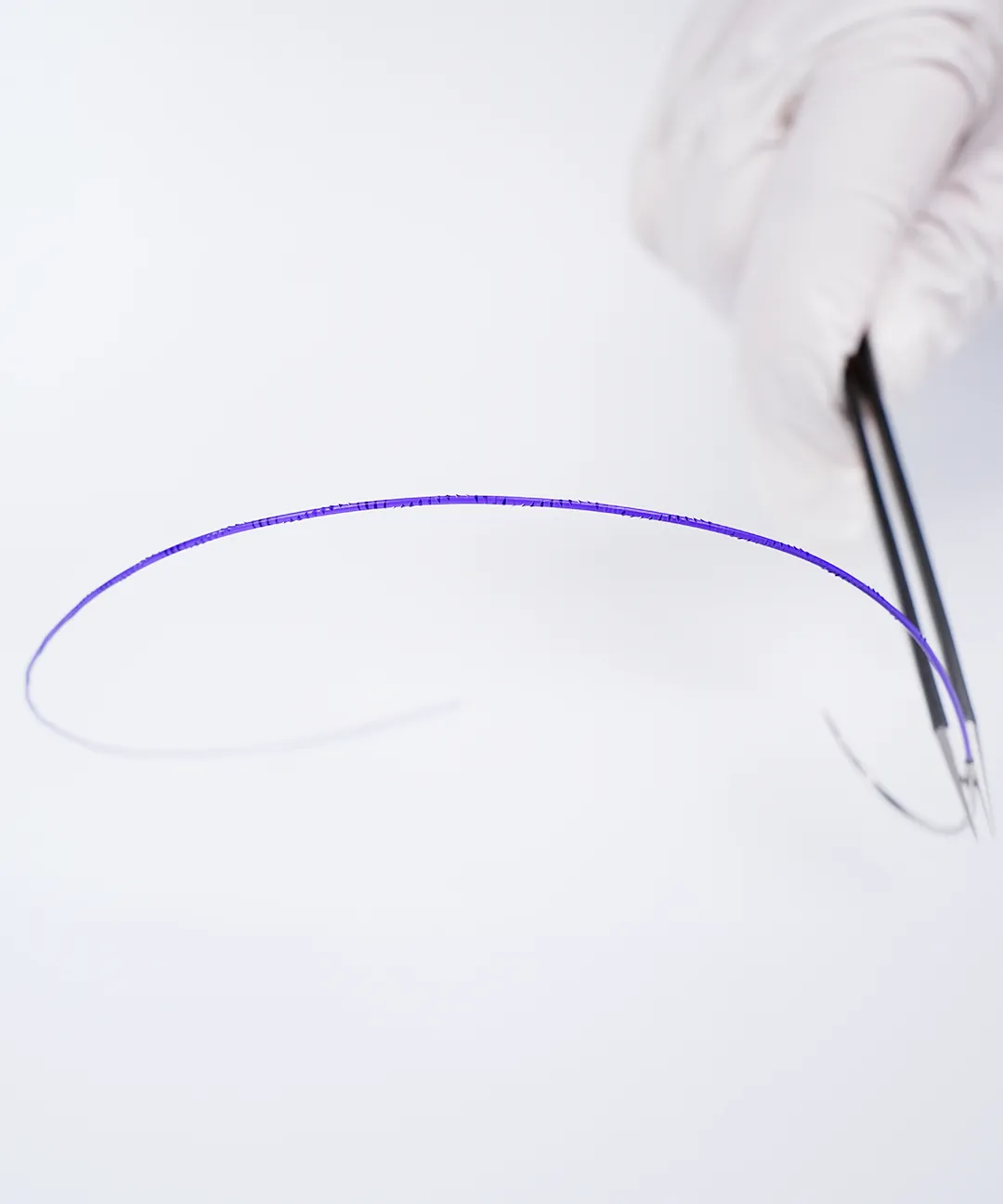
Specification of Knotless Absorbable Surgical Suture (Barbed)
| OS Series: Single/Double-Arm | |||||||||
| Suture Code | Size | Suture Length | Needle Point Type | shape | Needle Curvature | Circle | Suture | Needle Length mm | |
| H | 4-0 | 010, 015, 020, 025, 030, 035, 040, 045, 050, 055, 060, 065, 070, 075 | T | Taper point(flat) | E | 3/8 circle | H | 4-0 | 09-30 |
| I | 3-0 | 010, 015, 020, 025, 030, 035, 040, 045, 050, 055, 060, 065, 070, 075 | Y | Taper Cutting | K | 1/4 circle | I | 3-0 | 10-40 |
| J | 2-0 | 010, 015, 020, 025, 030, 035, 040, 045, 050, 055, 060, 065, 070, 075 | X | Dia Spatula | H | 1/2 circle | J | 2-0 | 16-60 |
| K | 0 | 010, 015, 020, 025, 030, 035, 040, 045, 050, 055, 060, 065, 070, 075 | Z | Trape Spatula | S | Straight | K | 0 | 25-75 |
| L | 1 | 010, 015, 020, 025, 030, 035, 040, 045, 050, 055, 060, 065, 070, 075 | R | Reverse Cutting | F | 5/8 circle | L | 1 | 25-80 |
| M | 2 | 010, 015, 020, 025, 030, 035, 040, 045, 050, 055, 060, 065, 070, 075 | D | Diamond Cutting | L | 1/2 curve | M | 2 | 25-80 |
| B | Blunt Point | B | Bi-Curve | ||||||
| OS Series: Double-Arm | |||||||||
| Suture Code | Size | Suture Length | MANI Code | shape | Needle Curvature | Circle | Suture | Needle Length mm | |
| H | 4-0 | 020, 030, 040, 050, 060, 070, 080, 090 | T | Taper point(flat) | E | 3/8 circle | H | 4-0 | 09-30 |
| I | 3-0 | 020, 030, 040, 050, 060, 070, 080, 090 | Y | Taper Cutting | K | 1/4 circle | I | 3-0 | 10-40 |
| J | 2-0 | 020, 030, 040, 050, 060, 070, 080, 090 | X | Dia Spatula | H | 1/2 circle | J | 2-0 | 16-60 |
| K | 0 | 020, 030, 040, 050, 060, 070, 080, 090 | Z | Trape Spatula | S | Straight | K | 0 | 25-75 |
| L | 1 | 020, 030, 040, 050, 060, 070, 080, 090 | R | Reverse Cutting | F | 5/8 circle | L | 1 | 25-80 |
| M | 2 | 020, 030, 040, 050, 060, 070, 080, 090 | D | Diamond Cutting | L | 1/2 curve | M | 2 | 25-80 |
| B | Blunt Point | B | Bi-Curve | ||||||
Why Choose Greatchina Biomed PPDO Barbed Suture
The Elite Tri-Advantage
In modern surgical interventions, efficiency and security cannot be compromised. While conventional sutures legacy-rely on manual knotting, Greatchina Biomed’s PPDO Absorbable Barbed Suture introduces a paradigm shift in dynamic wound closure. Inheriting over 30 years of advanced bioresorbable polymer research from the Chinese Academy of Sciences (CAS), our proprietary geometric barb engineering delivers a formidable technological moat across three clinical dimensions:
Knotless Surgical Efficiency (Zero-Knot Innovation):
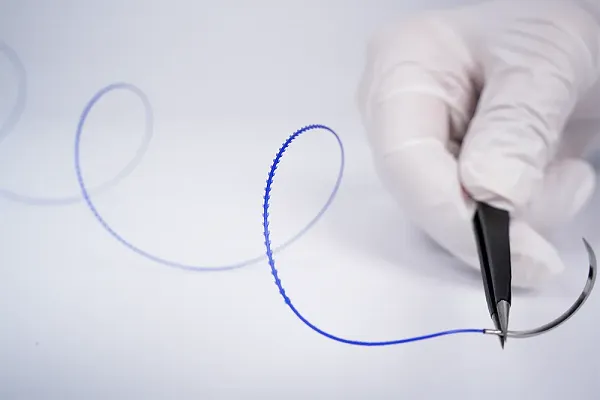
Our bi-directional and uni-directional barb distributions eliminate the necessity of traditional surgical knotting—the weakest point in conventional wound closure. This knotless design fundamentally streamlines clinical workflows, and mitigates the risk of post-operative knot-related complications or foreign body tissue reactions.
Formidable Tissue Holding Power (Uniform Tension Distribution):
Meticulously cut at optimized angles, the microscopic barbs deploy with exceptional mechanical consistency, anchoring firmly into the surrounding tissue. Unlike standard sutures that concentrate tension at a single knot, our barbed engineering distributes physical load uniformly along the entire length of the incision. This superior tissue holding capability ensures unparalleled gap prevention and structural integrity during early critical healing phases.
Minimized Learning Curve for Peak Compliance:
Engineered with high tactile feedback and smooth tissue passage, our barbed suture features an incredibly short learning curve for surgical teams. Surgeons can intuitively transition from traditional techniques to this advanced knot-free closure system with minimal specialized training. This high operational compliance guarantees consistent, predictable, and aesthetically superior cosmetic outcomes across laparoscopy, gynecology, and general surgeries worldwide.
FAQ
What are barbed sutures and what is their mechanism of action in wound closure?
Barbed sutures feature small evenly spaced projections cut into the surface that allow passage through tissue in one direction while resisting pullback. This creates multiple anchor points along the suture tract, eliminating the need for knots. Available in unidirectional or bidirectional configurations, they are made from absorbable polymers like polydioxanone. Barbed suture techniques distribute tension evenly and reduce operative time.
What are the primary benefits of barbed suture techniques compared to conventional suturing methods?
Primary benefits of barbed suture techniques include reduced operative time by eliminating knot tying, even tension distribution across the closure line, reduced infection risk by removing the knot as a bacterial nidus, improved tissue approximation without an assistant, potential hemostatic effect, and reduced need for surgical assistance. These advantages make barbed suture types increasingly popular in minimally invasive and robotic surgery.
In which surgical disciplines have barbed suture types gained the most widespread adoption?
Barbed suture types have gained widespread adoption in minimally invasive and robotic surgery for secure knotless closure, gynecologic surgery for uterine defect repair, plastic and reconstructive surgery for deep dermal closure with improved scar quality, orthopedic surgery for tendon and ligament repair, and general surgery for abdominal wall closure. Their knotless convenience and efficient handling make them versatile across multiple specialties.
How do barbed suture designs differ and what factors should influence suture barbed selection?
Barbed suture designs differ in barb orientation (unidirectional with all barbs facing one direction vs bidirectional with opposing barbs from a central point), barb geometry (depth, spacing, and angle affecting anchoring strength), absorbable material composition (polyglycolide-caprolactone for rapid absorption vs polydioxanone for extended support), and needle selection (taper-point for soft tissues, reverse-cutting for tough tissues). Selection factors include tissue type, healing rate, closure tension, and surgical approach.
What are the proper handling techniques and considerations when using barbed suture products?
Barbed suture handling requires inspecting barbs before use, passing the needle in the barb direction for proper engagement, placing each bite with desired tension since adjustment is not possible after anchoring, avoiding backward pull to prevent barb damage, and cutting the tail flush with tissue without knotting. Formal training is recommended before independent use of barbed suture products.


 Call us on:
  Email Us:
  Bldg 13, No.3 Hanshan Road, Xuejia Town, Xinbei District, Changzhou, Jiangsu 213125, China